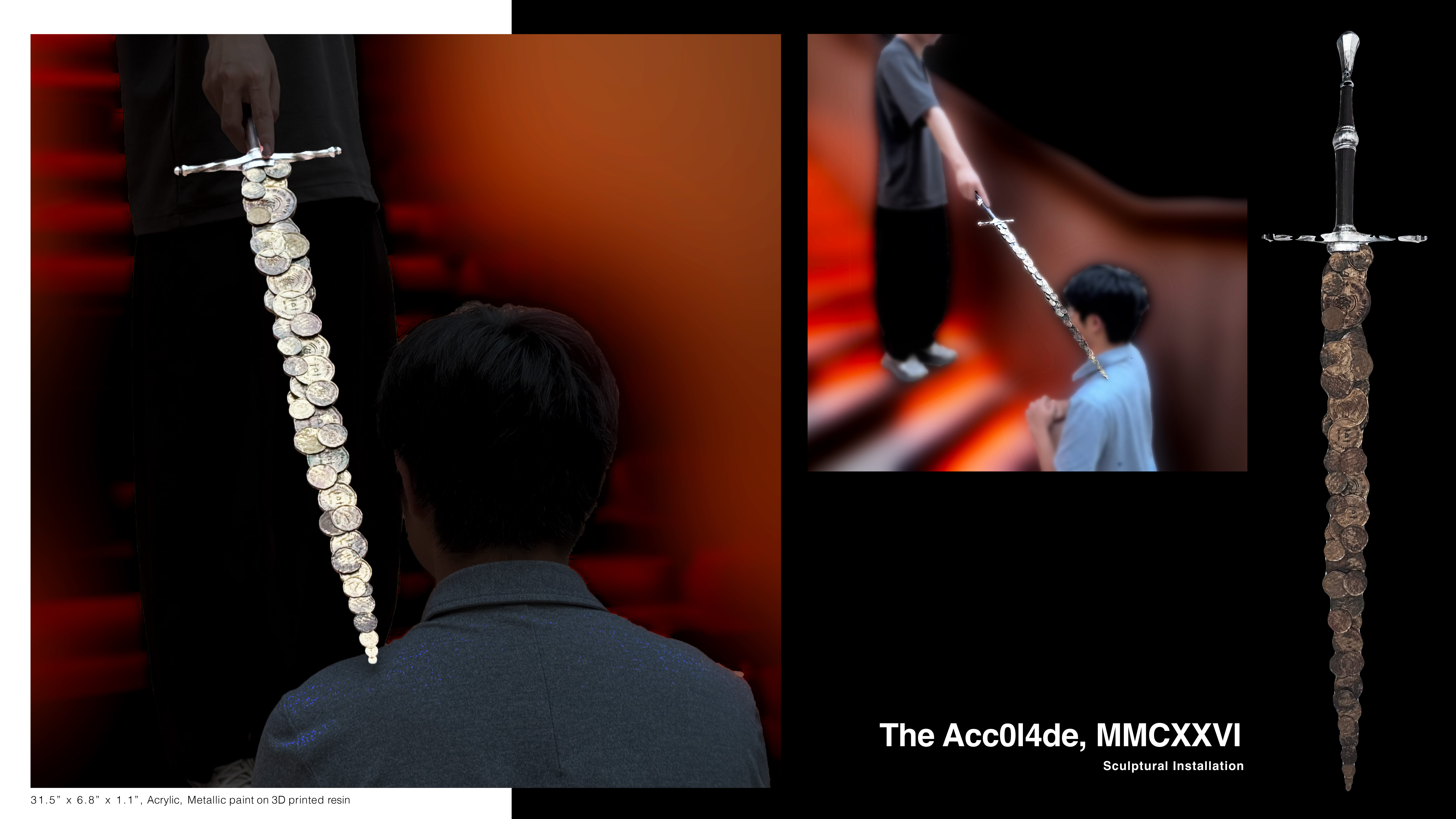
“The Acc0l4de, MMCXXVI” is a sculpture in which a ceremonial sword has its blade replaced by a run of minted coins. The title pays homage to Edmund Leighton's painting The Accolade (the moment a sovereign touches a blade to a subject's shoulder and confers rank) but vowels have been swapped for numerals, projecting the rite forward a century into 2126 (MMCXXVI), where sovereignty has always been minted before it is enforced.
Each historical register performs a distinct operation.The medieval register concerns allegiance itself: the knighting gesture, the feudal contract, and obligation flowing downward in exchange for protection. To be "knighted" by a tech corporation through tokens and micro-benefits is to enter a vassalage that feels like generosity.
The conceptual frame is Varoufakis's technofeudalism: platform capital has restored a pre-capitalist logic in which rent, not profit, organises power, and users are not consumers but serfs whose attention is harvested as tithe. The sword makes this tactile: a governance that dispenses small, cheap benefits in place of overt violence, because the cost of the benefit is lower than the cost of the blade.
Process
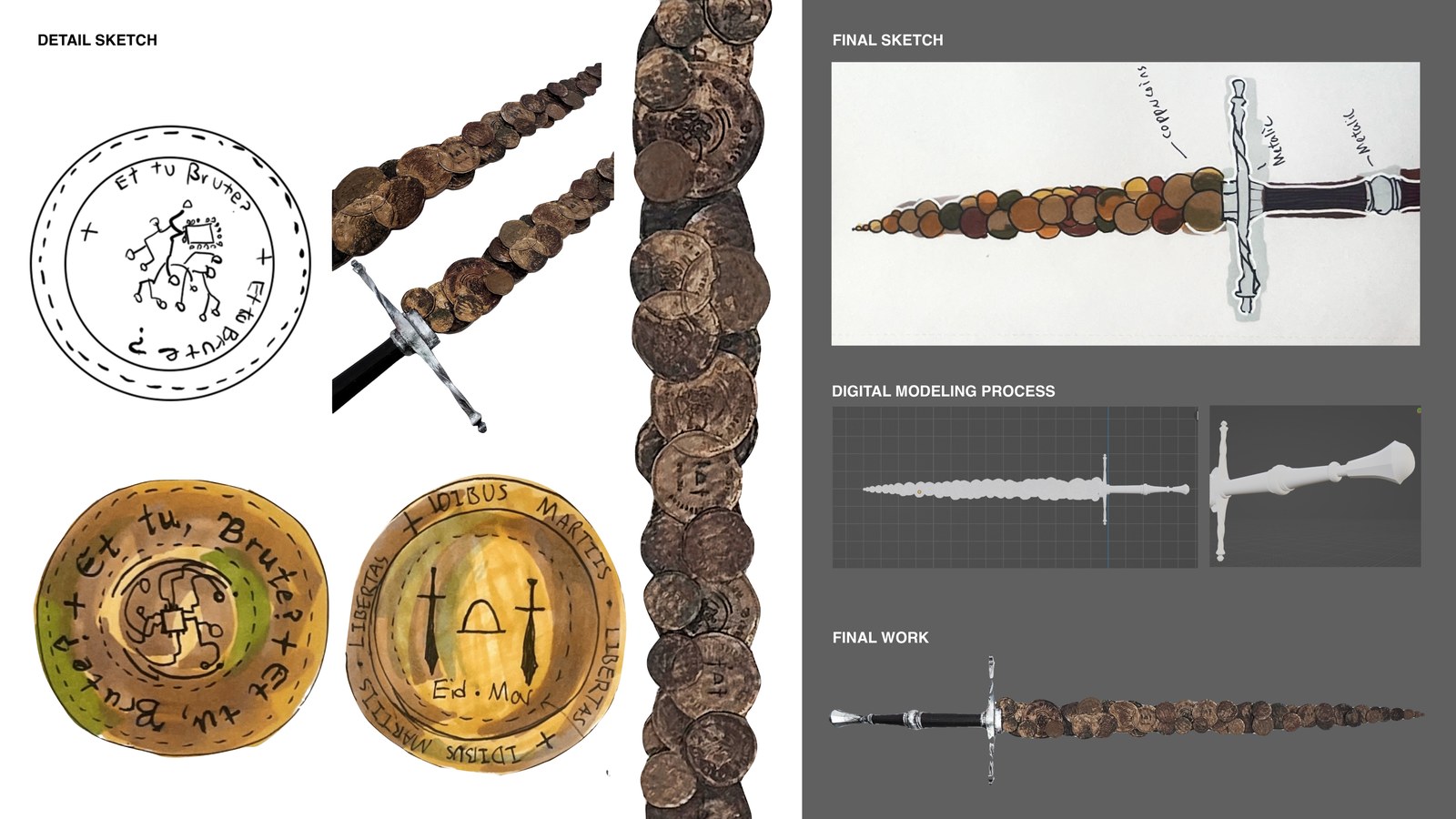
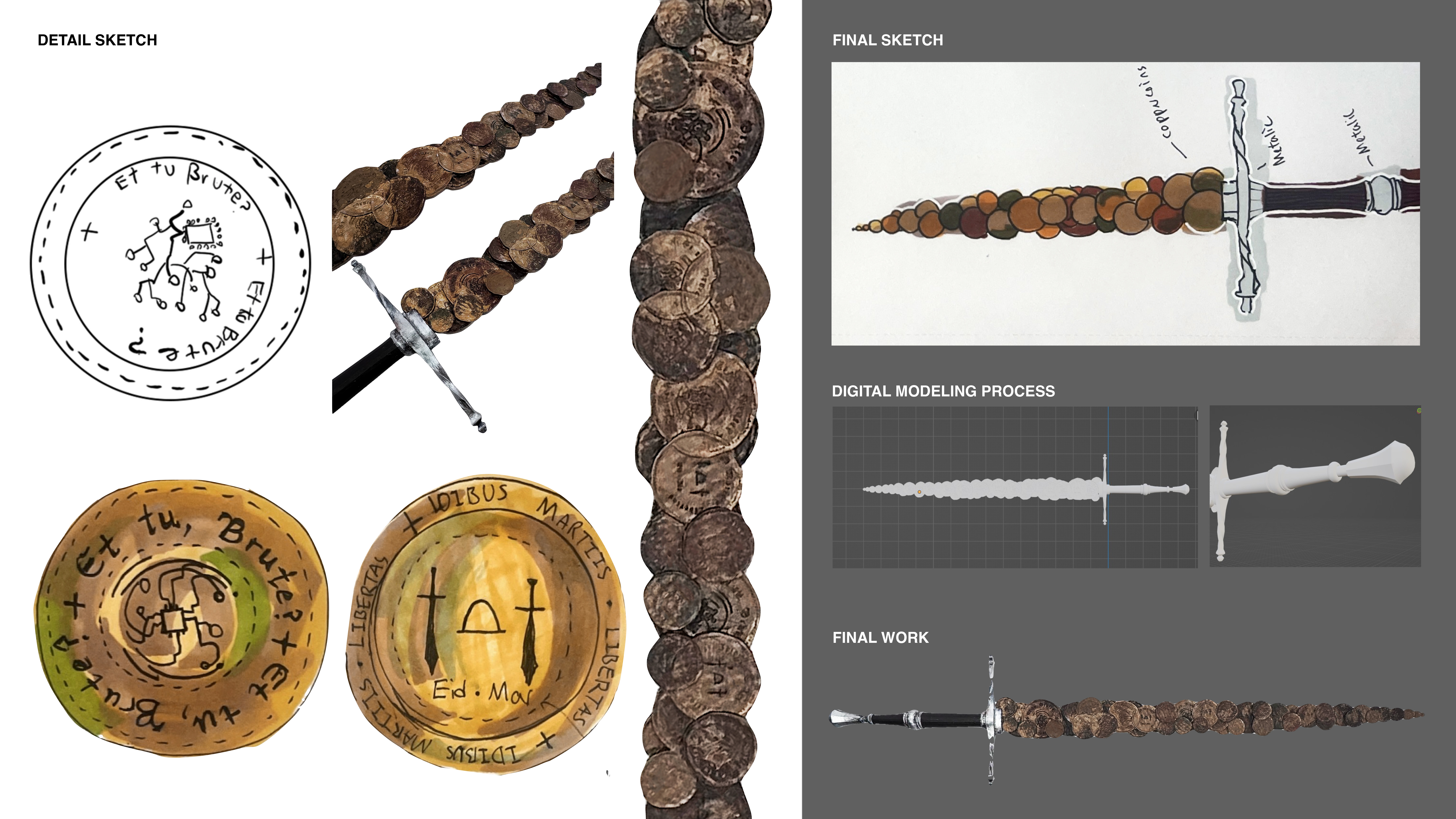
The blade is replaced by coins; the obverse recalls medieval coinage.
The Roman reference is specific to portraiture as a claim to rule: Caesar’s profile on the denarius in 44 BCE established the sovereign’s face as the guarantee of value.
A circuit-board pattern is etched at the center, its traces occupying the portrait field. The sovereign has been recomputed.
ET TU BRUTE(obverse): Inward-turned accusation; self-minted replacement
EID·MAR(reverse): Caesar’s assassination date as standing caution; warning of future AI–human role reversal
Gothic Black Letter: Typographic register of institutional decree; edicts, indulgences, binding obligations
Coin form: Pronouncement rather than object
The coin-blade follows a short lineage of “currency as tools” (the Taoist coin-sword; Mark Walker’s nausea; Gabriel Kvendseth’s Labor Capital). Where those materialize currency as a tool or weapon, this piece etches the coin itself to argue that the blade of state was always a blade of minted authority—and that the circuitry now specifies who holds the die.